The O.J. Simpson Case: The Trial That Divided America and Changed Criminal Justice Forever

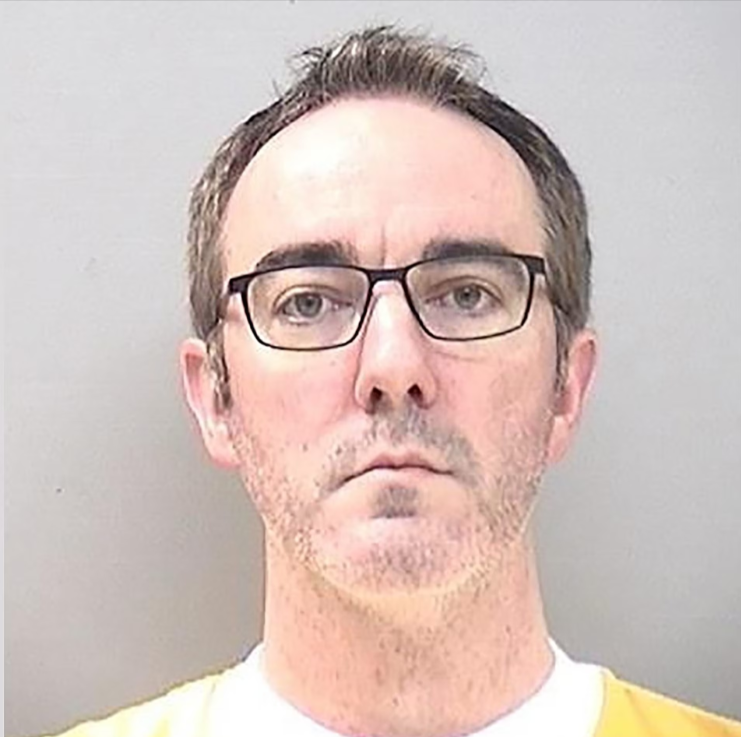
O.J. Simpson during his 1995 murder trial in Los Angeles
Case Summary
On June 12, 1994, Nicole Brown Simpson, 35, and Ronald Goldman, 25, were brutally murdered outside Nicole’s Brentwood condominium in Los Angeles. Nicole’s ex-husband, football legend O.J. Simpson, was charged with the double homicide. What followed was the “Trial of the Century”—a sensational 11-month criminal trial that exposed deep racial divides, police misconduct, and flaws in the American justice system. Despite overwhelming physical evidence, Simpson was acquitted on October 3, 1995. He was later found liable for the deaths in a 1997 civil trial and ordered to pay $33.5 million in damages.
The Night of the Murders
LOS ANGELES, Calif. – Shortly after 10:00 PM on June 12, 1994, neighbors heard the agonized wails of a dog near Nicole Brown Simpson’s condominium at 875 South Bundy Drive in the upscale Brentwood neighborhood of Los Angeles. Around midnight, a neighbor discovered Nicole’s white Akita dog wandering the streets with blood-stained paws, clearly distressed and attempting to lead people back toward Nicole’s home.
At approximately 12:10 AM on June 13, police arrived at the residence and made a horrifying discovery. Nicole Brown Simpson lay dead in a pool of blood at the bottom of the steps leading to her front door. Her throat had been slashed so deeply she was nearly decapitated. Just feet away lay the body of 25-year-old Ronald Goldman, a waiter and aspiring actor who had stopped by to return a pair of eyeglasses that Nicole’s mother had left at the Mezzaluna restaurant where he worked. Goldman showed signs of a fierce struggle—he had been stabbed more than 20 times in a brutal attack.
The Investigation Focuses on O.J. Simpson
Detectives immediately began investigating O.J. Simpson, Nicole’s ex-husband and father of her two children. The couple had a well-documented history of domestic violence. Simpson had pleaded no contest to spousal abuse in 1989 after beating Nicole, and police had responded to multiple domestic disturbance calls at their residence throughout their marriage.
On the night of the murders, Simpson had been scheduled to fly to Chicago for a business engagement. Detectives attempted to notify him of his ex-wife’s death and discovered he had already departed on a red-eye flight. When reached by phone at his Chicago hotel around 6:00 AM, Simpson’s reaction struck investigators as unusual—he did not ask how Nicole had died, only when it had happened.
The Evidence Mounts
The physical evidence against Simpson appeared overwhelming. Detectives discovered a trail of blood drops leading away from the crime scene. Blood matching Simpson’s DNA was found at the murder scene, on the back gate of Nicole’s property, and in Simpson’s white Ford Bronco. A bloody glove matching one found at the crime scene was discovered on Simpson’s property. Blood consistent with both victims was found in Simpson’s Bronco, on his driveway, and in his home.
Simpson had a cut on his left hand that he couldn’t adequately explain, claiming he had broken a glass in his Chicago hotel room when he learned of Nicole’s death. However, a limousine driver testified that he saw Simpson enter his Rockingham estate around 10:55 PM on the night of the murders—shortly after the estimated time of death—and that Simpson appeared agitated.
Forensic evidence revealed that fibers consistent with carpet from Simpson’s Bronco were found on the glove at the crime scene, and cashmere fibers consistent with a sweater found in Simpson’s bedroom were discovered on Ronald Goldman’s shirt. Hair consistent with Simpson’s was found on Goldman’s shirt and on the knit cap found at the crime scene.
The Bronco Chase That Stopped America
On June 17, 1994, Simpson was scheduled to surrender to police but instead fled in his white Ford Bronco, driven by his longtime friend Al Cowlings. What followed was one of the most surreal moments in American television history. An estimated 95 million people watched live as police pursued the Bronco at low speed along Southern California freeways for nearly two hours. Simpson, reportedly suicidal and carrying his passport, cash, and a disguise, spoke by cell phone with police negotiators while crowds gathered on freeway overpasses, many holding signs supporting him.
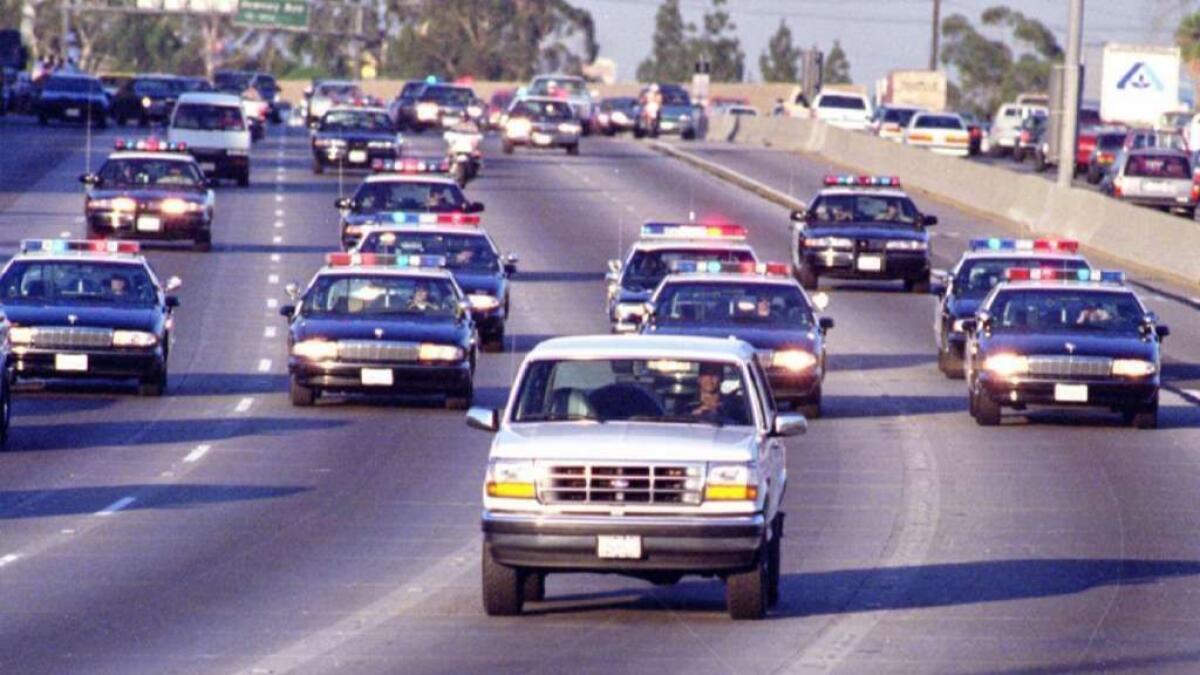
The infamous low-speed Bronco chase on June 17, 1994 – Source: Los Angeles Times
The chase ended at Simpson’s Brentwood estate, where he eventually surrendered after speaking with his mother by phone. The bizarre spectacle cemented the case’s status as a national obsession and foreshadowed the unprecedented media circus that would follow.
The “Trial of the Century”
The criminal trial, which began on January 24, 1995, was unlike anything American jurisprudence had ever seen. Cameras in the courtroom broadcast every moment to millions of viewers. The trial lasted 11 months, heard from 150 witnesses, and featured more than 1,000 pieces of evidence. Los Angeles County Superior Court Judge Lance Ito presided over the proceedings, which became a daily soap opera for a captivated nation.
The prosecution, led by Deputy District Attorneys Marcia Clark and Christopher Darden, presented what they believed was an insurmountable case built on forensic evidence, witness testimony, and Simpson’s history of domestic violence. They argued that Simpson had murdered his ex-wife in a jealous rage after seeing her with other men, and that Goldman had the misfortune of arriving during the attack.
Simpson’s “Dream Team” defense, led by attorneys Robert Shapiro, Johnnie Cochran, F. Lee Bailey, Alan Dershowitz, and Robert Kardashian, mounted a aggressive counterattack. They argued that Simpson had been framed by racist Los Angeles Police Department officers and that the crime scene had been contaminated, rendering the forensic evidence unreliable.
The Glove That Didn’t Fit
One of the trial’s most dramatic moments occurred on June 15, 1995, when prosecutor Christopher Darden asked Simpson to try on the blood-stained leather gloves found at the crime scene and Simpson’s property. In a decision that would haunt the prosecution, they had Simpson try on the gloves over latex gloves he was wearing. The gloves appeared too small, prompting Simpson to struggle visibly as he attempted to put them on.
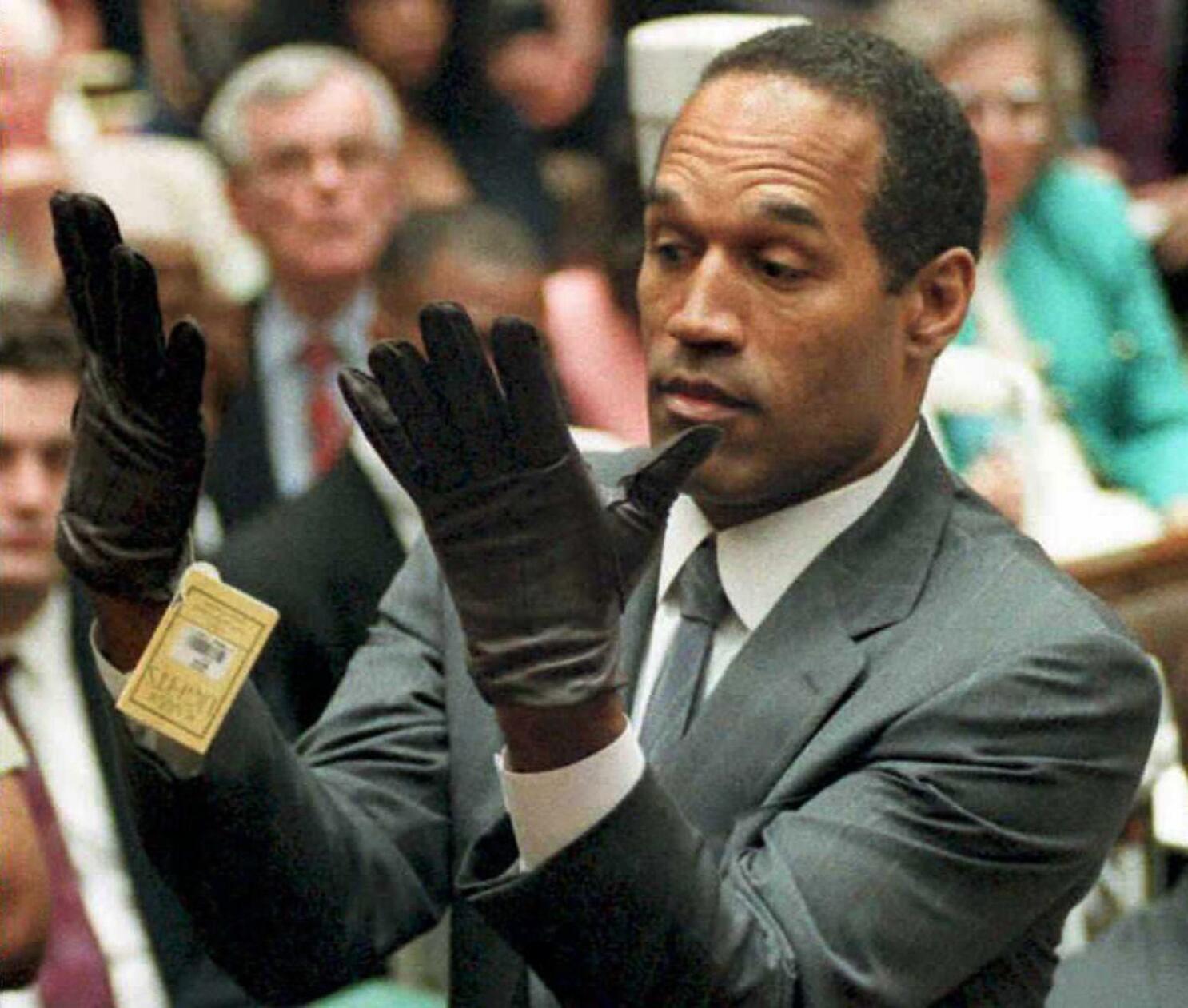
O.J. Simpson tries on the infamous gloves during trial – Source: Los Angeles Times
Defense attorney Johnnie Cochran seized on this moment in his closing arguments, delivering what would become one of the most famous lines in legal history: “If it doesn’t fit, you must acquit.” The prosecution later argued that the gloves had shrunk from being soaked in blood and frozen, and that Simpson had deliberately not taken his arthritis medication to make his hands swell. Nevertheless, the image of Simpson struggling with the gloves became an indelible moment that damaged the prosecution’s case.
The Race Card and Police Misconduct
The defense team successfully shifted focus from Simpson’s guilt to issues of race and police corruption. Detective Mark Fuhrman, who had found the bloody glove on Simpson’s property, became a central figure in the defense’s narrative. The defense produced audiotaped interviews in which Fuhrman repeatedly used racial slurs and boasted about planting evidence and beating suspects.
Despite having testified under oath that he had not used the N-word in the previous ten years, the tapes contradicted his testimony dozens of times. When recalled to the stand, Fuhrman invoked his Fifth Amendment right against self-incrimination. This severely damaged the prosecution’s case and lent credence to the defense’s theory that racist officers had framed Simpson.
The defense also highlighted questionable evidence collection procedures, including the fact that Detective Philip Vannatter had carried a vial of Simpson’s blood in his pocket for hours before booking it into evidence, and that some blood evidence had been found weeks after the initial crime scene investigation.
The Verdict That Divided a Nation
On October 3, 1995, after deliberating for less than four hours, the jury—consisting of nine African Americans, two whites, and one Hispanic—returned with their verdict. As the nation watched, O.J. Simpson was found not guilty of both murders. The courtroom erupted in gasps and sobs. The verdicts revealed a stark racial divide in America: polls showed that approximately 70% of white Americans believed Simpson was guilty, while approximately 70% of Black Americans believed he was innocent or that the prosecution had failed to prove guilt beyond a reasonable doubt.
The families of Nicole Brown Simpson and Ronald Goldman were devastated. Goldman’s father, Fred Goldman, would later write that the verdict represented “one of the most profound miscarriages of justice in American history.”
The Civil Trial and Financial Judgment
In 1997, the families of Nicole Brown Simpson and Ronald Goldman filed a civil wrongful death lawsuit against Simpson. Unlike criminal trials, civil cases require only a “preponderance of evidence” rather than proof “beyond a reasonable doubt.” Additionally, Simpson could not invoke his Fifth Amendment rights as he had already been acquitted in criminal court.
On February 4, 1997, a predominantly white jury found Simpson liable for the wrongful deaths and battery of Nicole Brown Simpson and Ronald Goldman. He was ordered to pay $33.5 million in damages—$8.5 million in compensatory damages to Goldman’s family and $25 million in punitive damages split between both families.
Simpson, who claimed to be nearly broke despite his NFL pension and other assets, has paid only a fraction of the judgment. In 2014, Fred Goldman told the media that Simpson had paid less than $100,000 of the judgment, though interest had increased the amount owed to over $40 million.
Later Years and Death
Simpson’s post-trial life was marked by continued controversy. In 2007, he was arrested in Las Vegas for armed robbery and kidnapping related to an incident in which he and several associates attempted to retrieve sports memorabilia that Simpson claimed was stolen from him. In 2008, he was convicted and sentenced to 33 years in prison with the possibility of parole after nine years.
Simpson was granted parole in July 2017 and released from prison in October 2017. He maintained his innocence in the murders until his death on April 10, 2024, from prostate cancer at age 76. To the end, he never confessed to the killings, though he had written a controversial book titled “If I Did It,” which was subsequently retitled by the Goldman family to emphasize “I Did It” after they won control of the book’s rights.
Legacy and Impact
The O.J. Simpson case fundamentally changed American criminal justice, media coverage of trials, and national conversations about race, domestic violence, and celebrity. It exposed deep fissures in American society regarding the justice system’s treatment of different races and economic classes. The trial demonstrated how wealth could assemble an elite legal team capable of creating reasonable doubt even in the face of substantial physical evidence.
The case also highlighted serious issues within the Los Angeles Police Department, leading to reforms in evidence handling and internal affairs investigations. It brought national attention to the issue of domestic violence, though critics argued that Simpson’s history of abuse was not adequately emphasized during the trial.
For the families of Nicole Brown Simpson and Ronald Goldman, the pain has never subsided. They have continued to speak publicly about the case, maintaining that justice was never truly served. The case remains one of the most analyzed and debated criminal trials in American history, continuing to generate documentaries, books, and scholarly analysis decades after the verdict.
If you or someone you know is experiencing domestic violence:
National Domestic Violence Hotline: 1-800-799-7233 (SAFE)
Text “START” to 88788
Additional Resources:
The National Coalition Against Domestic Violence: ncadv.org
RAINN (Rape, Abuse & Incest National Network): 1-800-656-HOPE (4673)
DISCLAIMER: All information presented in this article is based on publicly available court documents, trial transcripts, police reports, and credible news sources. O.J. Simpson was acquitted of criminal charges in 1995 but was found liable in a civil trial in 1997. Crime Recap makes no independent claims beyond what has been established through legal proceedings. For our complete legal disclaimer, please visit our Legal Disclaimer page.