Jeffrey Dahmer: The Milwaukee Cannibal Who Shocked the World with Unspeakable Acts of Horror

Jeffrey Dahmer’s 1991 police mugshot after his arrest in Milwaukee. His crimes would shock the world and expose systemic failures in law enforcement.
Case Summary
Between 1978 and 1991, Jeffrey Lionel Dahmer murdered 17 young men and boys in one of the most gruesome series of serial killings in American history. Known as the “Milwaukee Cannibal,” Dahmer didn’t just kill his victims—he drugged them, strangled them, had sex with their corpses, dismembered their bodies, photographed the process, and kept body parts as trophies. He ate portions of several victims and attempted to create “living zombies” by drilling holes into victims’ skulls and injecting acid into their brains. Most of his victims were young gay men, many of them minorities from Milwaukee’s marginalized communities. Dahmer’s arrest in July 1991 revealed an apartment of horrors containing severed heads, body parts, photographs of dismembered corpses, and evidence of unspeakable depravity. He was sentenced to 16 consecutive life terms but was beaten to death by a fellow inmate in 1994, just two years into his sentence.
The Making of a Monster
Jeffrey Lionel Dahmer was born on May 21, 1960, in Milwaukee, Wisconsin, to Lionel and Joyce Dahmer. By most outward accounts, his early childhood appeared normal. His father was a chemistry student working toward his PhD, and his mother was a teletype machine instructor. The family moved to Bath Township, Ohio, when Jeffrey was young.
However, beneath the surface of suburban normalcy, Jeffrey’s childhood was troubled. His mother suffered from depression and illness, requiring medication throughout her pregnancy. She was frequently bedridden, leaving Jeffrey largely to his own devices. His parents’ marriage was tumultuous, marked by constant arguments that would eventually lead to divorce.
As a child, Jeffrey was described as shy and withdrawn. He had few friends and seemed unable to connect with others emotionally. Around age six, he underwent hernia surgery, after which his personality noticeably changed. He became more introverted and detached. By adolescence, he was showing troubling behaviors that would foreshadow his future crimes.
Jeffrey developed a morbid fascination with dead animals. He would collect roadkill and animal carcasses, dissecting them in the woods behind his house. His father, a chemist, had taught him how to bleach and preserve animal bones—knowledge Jeffrey would later use on human remains. He kept jars of preserved animal parts in a shed, creating what he called his “fiddler collection.”
In high school, Jeffrey began drinking heavily, often arriving at school intoxicated. Despite this, he managed to graduate in 1978. His classmates remembered him as a class clown who would do outrageous things for attention, but few suspected the darkness growing inside him. Years later, former classmates would recall finding his behavior unsettling and strange.
During his teenage years, Jeffrey also realized he was gay, though he never acted on his attraction during high school. This internal conflict, combined with his emotional isolation, heavy drinking, and obsessive thoughts about violence and control, created a toxic psychological stew. By graduation, Jeffrey Dahmer was a deeply disturbed young man teetering on the edge of becoming something monstrous.

Jeffrey Dahmer’s high school yearbook photo from 1978. Classmates remembered him as a loner who drank heavily and engaged in bizarre attention-seeking behavior.
The First Murder: Steven Hicks
On June 18, 1978, just three weeks after graduating from high school, 18-year-old Jeffrey Dahmer committed his first murder. His parents’ divorce had been finalized, his mother had moved out with his younger brother David, and his father was staying in a motel. Jeffrey was alone in the family home.
That day, Dahmer picked up 19-year-old hitchhiker Steven Hicks, who was on his way to a rock concert. Dahmer invited Hicks back to his house to drink beer and listen to music. When Hicks said he wanted to leave, Dahmer didn’t want to be alone. He struck Hicks twice in the head with a 10-pound dumbbell, killing him.
What Dahmer did next would establish a pattern he would repeat with future victims. He dragged Hicks’s body to the crawl space under the house, where he masturbated while lying on top of the corpse. He then dismembered the body with a knife, placed the parts in garbage bags, and buried them behind the house. Later, worried the remains might be discovered, he dug them up, stripped the flesh from the bones, and smashed the bones into fragments with a sledgehammer before scattering them in the woods.
Remarkably, Dahmer would not kill again for nine years. Steven Hicks’s disappearance remained unsolved until Dahmer confessed to the murder in 1991. Hicks’s family spent 13 years not knowing what had happened to their son. His father lived with the anguish of uncertainty until Dahmer’s confession finally gave him answers—though they were answers no parent wants to hear.
The Dormant Period: College, Army, and Descent
After the murder of Steven Hicks, Dahmer attempted to live a normal life. In January 1979, he enlisted in the U.S. Army at his father’s urging. He trained as a medical specialist and was stationed in West Germany. However, his drinking continued and worsened. He was often drunk on duty, and his fellow soldiers found him odd and kept their distance.
In 1981, after two years of service, Dahmer was discharged from the Army due to his alcohol abuse. He returned to Ohio briefly before moving to Florida, where he lived in a cheap motel and survived on money sent by his father. After being arrested for disorderly conduct, he was sent back to Ohio.
In 1982, Dahmer moved to Milwaukee to live with his grandmother, Catherine Dahmer. She provided him with structure and support, and for a while, things seemed to stabilize. He found work at a blood plasma center and later at the Ambrosia Chocolate Factory. But beneath this façade of normalcy, Dahmer’s dark compulsions were building.
He began frequenting gay bathhouses and bars in Milwaukee, though he had difficulty forming connections with other men. His drinking intensified. He developed elaborate fantasies about having a completely submissive partner—someone who could never leave him. These fantasies would eventually manifest in the most horrific ways imaginable.
1987-1989: The Killing Resumes
In September 1987, nine years after murdering Steven Hicks, Dahmer killed again. He met 24-year-old Steven Tuomi at a gay bar and took him to the Ambassador Hotel. Dahmer claimed he had no memory of killing Tuomi, saying he woke up to find the man dead beside him with bruises on his chest. Whether true or not, Dahmer dismembered Tuomi’s body in the hotel room, packed it into a suitcase, took it back to his grandmother’s basement, and disposed of the remains.
The floodgates had opened. Over the next year and a half, Dahmer killed three more victims at his grandmother’s house: 14-year-old James Doxtator in January 1988 and 22-year-old Richard Guerrero in March 1988. His methods were becoming refined. He would lure young men from gay bars, bus stops, or shopping malls with offers of money to pose for photographs or to drink alcohol. Once at his grandmother’s house, he would drug them, strangle them, and then have sex with their corpses before dismembering them.
In September 1988, Dahmer’s crimes nearly came to an end. He offered a 13-year-old Laotian boy named Somsack Sinthasomphone $50 to pose for photographs. Dahmer drugged the boy, but before he could kill him, the boy managed to escape. Dahmer was arrested and charged with second-degree sexual assault and enticing a child for immoral purposes.
During his trial, Dahmer presented himself as remorseful and claimed he had a drinking problem. Prosecutors recommended five years in prison, but the judge sentenced him to just one year in a work release program and five years’ probation. He served 10 months before being released in March 1990. The system had failed spectacularly—if Dahmer had been properly imprisoned, 12 lives would have been saved.
Before his arrest, Dahmer had killed one more victim: 26-year-old Anthony Sears in March 1989. This time, Dahmer kept Sears’s skull and genitals as trophies, painting the skull gray to make it look like plastic. His grandmother, disturbed by the smells and strange noises coming from the basement, asked him to move out. In May 1990, Dahmer moved into apartment 213 at 924 North 25th Street in Milwaukee—a location that would become synonymous with unimaginable horror.
The Oxford Apartments at 924 North 25th Street in Milwaukee where Dahmer committed 12 murders. The building was demolished in 1992.
1990-1991: The Apartment of Death
In his new one-bedroom apartment, freed from the constraints of living with his grandmother, Dahmer’s killing accelerated dramatically. Between May 1990 and July 1991, he murdered 12 young men in apartment 213—an average of one killing per month. His methods became increasingly elaborate and disturbing.
After luring victims to his apartment, Dahmer would offer them drugged drinks. Once unconscious, he would strangle them and then photograph their bodies in various poses. He would have sex with the corpses, sometimes for hours or even days after death. He would then dismember the bodies in his bathtub, often keeping skulls, genitals, and other body parts as trophies.
Dahmer began experimenting with ways to preserve his victims. He kept severed heads in his refrigerator and freezer. He attempted to create what he called a “temple” using painted skulls, which he planned to arrange around a black table with blue lights. He stored skeletons and body parts throughout the apartment. The smell of decomposition was overwhelming, yet neighbors’ complaints to the landlord went uninvestigated.
Most disturbing were Dahmer’s attempts to create “living zombies”—compliant sex slaves who would never leave him. He would drill holes into victims’ skulls while they were unconscious or sedated and inject hydrochloric acid or boiling water into their frontal lobes. These experiments were always fatal, though Dahmer claimed he hoped to keep the victims alive in a permanent vegetative state.
Dahmer also engaged in cannibalism. He later told investigators he believed that by eating his victims, they would become part of him forever. He kept portions of flesh in his freezer and admitted to eating parts of several victims. This aspect of his crimes earned him the nickname “The Milwaukee Cannibal.”
As his apartment filled with human remains—police would later find seven skulls, multiple severed heads, body parts in the freezer, and a human heart—neighbors grew increasingly concerned. They complained about terrible smells, strange sounds, and Dahmer’s odd behavior. Sandra Smith, who lived in the building, reported hearing what sounded like someone falling and objects being dragged across the floor. Glenda Cleveland, whose daughter Dahmer approached, called police multiple times about suspicious activity. All concerns were dismissed or inadequately investigated.
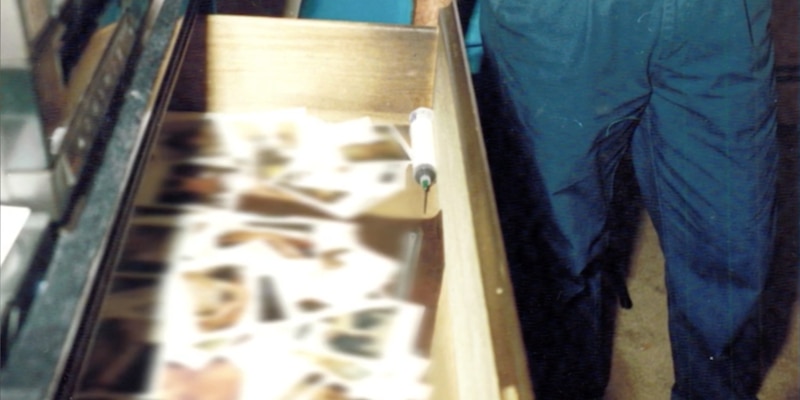
Evidence photos from Dahmer’s apartment showed the horrific scope of his crimes, including Polaroid photographs he took of his victims’ bodies and dismemberment process.
The Konerak Sinthasomphone Tragedy
On May 27, 1991, an incident occurred that should have stopped Dahmer’s killing spree but instead exposed catastrophic failures in the Milwaukee Police Department. Fourteen-year-old Konerak Sinthasomphone—the younger brother of the boy Dahmer had molested in 1988—was lured to Dahmer’s apartment. Dahmer drugged him and drilled a hole in his skull, injecting acid into his brain.
While Dahmer left the apartment to buy beer, Konerak managed to escape despite his injuries and stumbled outside, naked, bleeding, and incoherent. Three African American women—Sandra Smith, Tina Spivey, and Nicole Childress—found the boy and called 911. They tried to help him and prevent Dahmer from taking him back when Dahmer arrived on the scene.
Milwaukee Police Officers John Balcerzak and Joseph Gabrish responded to the call. Despite the women’s protests that something was seriously wrong, the officers listened to Dahmer, who claimed Konerak was his 19-year-old boyfriend and they’d had a lover’s quarrel. Dahmer was calm, articulate, and convincing—appearing to be the responsible adult in the situation.
The officers escorted Dahmer and the boy back to Dahmer’s apartment. Had they run Dahmer’s name through their system, they would have discovered he was a registered sex offender on probation. Had they investigated the apartment, they would have found the body of Tony Hughes, murdered three days earlier, lying on Dahmer’s bedroom floor. Instead, they accepted Dahmer’s story and left the boy with him.
The officers even joked about the incident on their radio, with one saying: “Intoxicated Asian, naked male, was returned to his sober boyfriend.” They later wrote in their report that it appeared to be a domestic dispute between two adults. Within hours of the police leaving, Dahmer strangled Konerak Sinthasomphone to death.
When this incident came to light after Dahmer’s arrest, it sparked outrage in Milwaukee’s community, particularly among minorities and the LGBTQ community. Officers Balcerzak and Gabrish were fired, though they successfully appealed and were reinstated in 1994. The case highlighted systemic issues of racism, homophobia, and police negligence—a 14-year-old boy of color had been handed back to his killer because officers didn’t take the situation seriously.
July 22, 1991: The Arrest
On the evening of July 22, 1991, Dahmer approached 32-year-old Tracy Edwards at a shopping mall, offering him money to come to his apartment for drinks and to pose for photographs. Edwards, who needed cash, agreed. At the apartment, Dahmer gave Edwards a drink, which may have been drugged though Edwards didn’t drink much of it. The two sat watching The Exorcist III on television.
Suddenly, Dahmer’s demeanor changed. He handcuffed Edwards’s wrist and pulled out a large knife, pressing it against Edwards’s chest. “I’m going to eat your heart,” Dahmer said calmly. Edwards realized he was fighting for his life. For the next hour, Edwards talked to Dahmer, trying to calm him down while looking for an opportunity to escape.
When Edwards asked to use the bathroom, Dahmer led him to the bedroom. There, Edwards saw Polaroid photographs of dismembered bodies covering the walls. He saw more photos of people in various states of death and dismemberment. The horror of what he was seeing gave Edwards a surge of adrenaline. When Dahmer briefly let his guard down, Edwards punched him in the face and fled the apartment with one handcuff still dangling from his wrist.
Edwards ran into the street at about 11:30 PM and flagged down a police car driven by Officers Robert Rauth and Rolf Mueller. Breathless and terrified, Edwards told them a man had threatened to kill and eat him. He led the officers back to Dahmer’s apartment. When Dahmer answered the door, he appeared calm and tried to explain away the handcuffs, saying he and Edwards had been drinking and things got out of hand.
But Officer Mueller noticed the photographs Edwards had described. Entering the bedroom to retrieve the handcuff key, Mueller opened a drawer and found dozens of Polaroid photographs showing men in various poses—some alive, some clearly dead, some dismembered. “These are real,” Mueller said to his partner. Dahmer tried to resist arrest, but the officers quickly subdued him.
What investigators found in apartment 213 has been described as resembling a slaughterhouse. In the refrigerator: a severed head. In the freezer: three more severed heads, multiple bags of internal organs, and packages of frozen human flesh. Seven skulls were found throughout the apartment, some painted, some being prepared for Dahmer’s planned altar. A human heart was in the freezer. A vat of acid contained dissolving torsos. The file cabinet held more Polaroids documenting the entire process of murder and dismemberment.
The medical examiner later stated that Dahmer’s apartment was “more like dismantling someone’s museum than an actual crime scene.” FBI forensic analysts worked alongside local investigators to identify remains and match them to missing persons. It was one of the most complex forensic investigations in American history.

Tracy Edwards, the man who escaped from Dahmer and led police to his apartment, preventing further murders. Edwards died in 2023 at age 63.
The Confession and Investigation
Beginning in the early hours of July 23, 1991, Dahmer was questioned by Detective Patrick Kennedy. Over two weeks of interrogations totaling more than 60 hours, Dahmer confessed to 17 murders in chilling detail. He waived his right to have a lawyer present, stating: “I created this horror and it only makes sense I do everything to put an end to it.”
Dahmer’s confessions were eerily calm and matter-of-fact. He described each murder methodically, explaining how he lured victims, drugged them, killed them, and dismembered them. He admitted to having sex with the corpses, sometimes for days after death. He discussed his experiments with trying to create zombie-like servants. He revealed his cannibalism, explaining which victims he had eaten and why.
Investigators worked to identify all of Dahmer’s victims. Most were young gay men, many from Milwaukee’s marginalized communities. Many were African American, Asian, or Latino. Some were struggling with poverty, addiction, or homelessness. Several had been reported missing, but their disappearances had not been adequately investigated.
The victim identifications painted a picture of young men whose lives were cut short: Steven Tuomi (24), James Doxtator (14), Richard Guerrero (22), Anthony Sears (26), Raymond Smith (28), Edward Smith (28), Ernest Miller (22), David Thomas (23), Curtis Straughter (17), Errol Lindsey (19), Tony Hughes (31), Konerak Sinthasomphone (14), Matt Turner (20), Jeremiah Weinberger (23), Oliver Lacy (23), Joseph Bradehoft (25), and Steven Hicks (19).
Each victim had a story, a family, and people who loved them. Errol Lindsey’s sister never got to meet her nephew—Lindsey’s girlfriend was six months pregnant when he was killed. Tony Hughes was a deaf man with dreams of owning his own business. Curtis Straughter was saving money for culinary school. Matt Turner had left his family in Chicago to attend Pride festivities in Milwaukee. These were real people, not just names on a list of victims.
The Trial: Guilty But Insane?
Dahmer’s trial began on January 30, 1992, at the Milwaukee County Circuit Court. He pleaded guilty but insane to 15 murder charges (the Wisconsin charges; he would be tried separately for Steven Hicks’s murder in Ohio). The only question for the jury was whether Dahmer was legally insane at the time of the murders.
The defense argued that Dahmer suffered from mental illness that made him unable to control his actions. They presented psychiatric experts who diagnosed him with various disorders including necrophilia, paraphilia, and personality disorders. The defense painted Dahmer as a deeply sick individual driven by compulsions beyond his control.
The prosecution countered that Dahmer was perfectly sane—he knew exactly what he was doing, took elaborate steps to avoid detection, and made rational decisions throughout his crimes. He held down jobs, paid his bills, and functioned in society. His ability to lure victims, avoid police, and cover his tracks demonstrated clear thinking and planning. Prosecutor E. Michael McCann argued that Dahmer chose to commit these crimes; he wasn’t compelled by mental illness.
The trial was emotionally devastating for victims’ families. Many testified about the impact of losing their loved ones. Rita Isbell, sister of Errol Lindsey, gave a particularly powerful statement, screaming at Dahmer in court: “I want to know if I can kill Jeffrey Dahmer? Is that okay with you? Is that okay with you?” Her raw pain captured the unimaginable grief Dahmer had inflicted.
On February 15, 1992, after just five hours of deliberation, the jury found Dahmer guilty but sane on all 15 counts. They rejected the insanity defense, determining that Dahmer knew what he was doing was wrong and had the capacity to control his actions. Judge Laurence Gram sentenced him to 15 consecutive life terms—a total of 957 years in prison. In May 1992, Dahmer was sentenced to a 16th life term for Steven Hicks’s murder.

Jeffrey Dahmer in court during his 1992 trial. He showed little emotion throughout the proceedings and offered no explanation for his actions beyond claiming compulsion.
Prison and Death
Dahmer was sent to the Columbia Correctional Institution in Portage, Wisconsin. Initially placed in solitary confinement for his own protection, he was later transferred to a less secure unit. Dahmer reportedly became a born-again Christian in prison and claimed to have found remorse for his crimes, though many questioned the sincerity of this conversion.
On November 28, 1994, just two years into his sentence, Dahmer was assigned to a work detail in the prison gymnasium with two other inmates: Jesse Anderson and Christopher Scarver. A corrections officer left the three men unattended for approximately 20 minutes. When he returned, he found Dahmer and Anderson severely beaten. Scarver had attacked both men with a 20-inch metal bar from the prison weight room.
Dahmer died from severe head trauma on his way to the hospital. Anderson died two days later. Scarver, who was serving a life sentence for murder, later said he was disgusted by Dahmer’s crimes and that Dahmer had done little to protect himself during the attack. Scarver claimed Dahmer had been taunting other inmates by fashioning his food into severed limbs and drizzling packets of ketchup over them to simulate blood.
At 34 years old, Jeffrey Dahmer was dead. His cremated remains were divided between his parents, who had battled in court over whether to preserve or destroy his brain for scientific study. Ultimately, a judge ordered the brain destroyed along with the rest of his remains.
The Aftermath: Systemic Failures and Victims’ Justice
Dahmer’s case exposed catastrophic failures at multiple levels of law enforcement and the justice system. The Milwaukee Police Department’s handling of the Konerak Sinthasomphone case became a national scandal. How could officers have returned a drugged, naked 14-year-old boy to his killer without conducting even a basic investigation?
The case also highlighted how marginalized communities—particularly gay men of color—were failed by systems meant to protect them. Many of Dahmer’s victims had been reported missing, but their cases received minimal attention. Dahmer was able to operate for years in part because society didn’t prioritize the safety of the people he targeted.
The criminal justice system’s failure to properly punish Dahmer after his 1988 sexual assault of a minor allowed him to kill 12 more people. Had he received the five-year prison sentence prosecutors recommended, those victims would still be alive. Instead, he served just 10 months in a work release program that allowed him to continue living near his grandmother’s house.
For the families of Dahmer’s victims, justice was incomplete. Many felt Dahmer’s death prevented them from getting full closure. Shirley Hughes, mother of victim Tony Hughes, said after Dahmer’s death: “I hoped he would burn in hell, I didn’t want him to die that quick… I wanted him to feel the pain my son felt.” Others expressed relief that they wouldn’t have to endure parole hearings or further court proceedings.
The Oxford Apartments building where Dahmer committed most of his murders became a macabre tourist attraction. To prevent this exploitation, the building was purchased by the Campus Circle Project and demolished in November 1992. The site remains empty today, a void where unspeakable horror once occurred.
Understanding the Incomprehensible
How does someone become Jeffrey Dahmer? Psychologists, forensic psychiatrists, and criminal profilers have studied his case extensively, trying to understand what created such a monster. The answers remain complex and disturbing.
Dahmer himself offered various explanations over the years. He cited loneliness, saying he didn’t want his partners to leave him. He described compulsive sexual fantasies that began in adolescence and grew increasingly violent. He acknowledged his actions were wrong but claimed he couldn’t stop himself. He blamed his alcoholism for lowering his inhibitions, though he committed his crimes while sober.
Mental health professionals diagnosed Dahmer with multiple conditions including necrophilia, borderline personality disorder, schizotypal personality disorder, and psychotic disorder. However, these diagnoses don’t fully explain why he progressed from fantasizing about control to murder, dismemberment, and cannibalism. Many people have mental illness without becoming serial killers.
What made Dahmer particularly dangerous was the combination of factors: childhood trauma and emotional neglect, early development of violent sexual fantasies, extreme social isolation, substance abuse, lack of empathy, and an obsessive need for control. His intelligence and ability to appear normal allowed him to evade detection. His targeting of marginalized victims whom society undervalued enabled him to continue killing.
Dr. Park Dietz, a forensic psychiatrist who examined Dahmer, concluded he was legally sane but profoundly disturbed. Dahmer understood right from wrong, could control his behavior when motivated (such as when talking to police), and took elaborate steps to avoid getting caught. He chose his victims carefully, planned his crimes, and successfully maintained the facade of normalcy.
FBI profiler Robert Ressler, who interviewed Dahmer extensively, noted that Dahmer was different from many serial killers because he showed genuine remorse in some moments, yet continued killing anyway. This suggested a level of psychological complexity that defied easy categorization. Dahmer wasn’t simply evil—he was something more complicated and more frightening: a human being who became monstrous through a perfect storm of psychology, circumstance, and choice.
Cultural Impact and Media Coverage
Jeffrey Dahmer’s case has become one of the most discussed and analyzed serial killer cases in history. The shocking nature of his crimes, combined with the systemic failures that enabled them, has kept the case in the public consciousness for over three decades.
Numerous books have been written about Dahmer, including “A Father’s Story” by his father Lionel Dahmer, who struggled to understand how his son became a monster. Brian Masters’s “The Shrine of Jeffrey Dahmer” provided a detailed psychological examination. Anne E. Schwartz, the Milwaukee Journal reporter who broke the story, wrote “The Man Who Could Not Kill Enough.”
The 2002 film “Dahmer” starring Jeremy Renner depicted the killer’s life. In 2017, “My Friend Dahmer” explored his high school years based on a graphic novel by his former classmate Derf Backderf. Most recently, Netflix’s 2022 series “Monster: The Jeffrey Dahmer Story” starring Evan Peters became one of the platform’s most-watched shows, though it faced criticism from victims’ families for exploiting their pain.
The renewed interest in Dahmer’s case has sparked debate about society’s fascination with serial killers. Some argue these stories serve important educational purposes and help us understand criminal psychology. Others contend that sensationalizing such crimes disrespects victims and their families while potentially inspiring copycat criminals.
Several victims’ families expressed outrage at the Netflix series, stating they were not contacted or compensated. Rita Isbell, whose victim impact statement went viral after being recreated in the show, said she was never notified about the production. Shirley Hughes’s family said they were traumatized anew by having to relive Tony Hughes’s murder through media coverage of the series.
The Victims: More Than a List of Names
In the decades since Dahmer’s arrest, efforts have been made to remember his victims not as statistics but as individuals whose lives had value. Each person Dahmer murdered was someone’s son, someone’s brother, someone’s friend. They had dreams, personalities, and futures that were stolen from them.
Steven Hicks wanted to attend a rock concert. Steven Tuomi worked as a short-order cook and had many friends. James Doxtator had run away from an abusive home, seeking safety. Richard Guerrero was saving money for his future. Anthony Sears was a model with a promising career ahead. Raymond Smith aspired to be a teacher. Edward Smith left behind a young daughter. Ernest Miller dreamed of owning his own dance studio.
David Thomas was trying to get his life together. Curtis Straughter wanted to be a chef. Errol Lindsey was about to become a father. Tony Hughes overcame his deafness to build a life for himself. Konerak Sinthasomphone was just a child starting to discover who he wanted to be. Matt Turner, Jeremiah Weinberger, Oliver Lacy, and Joseph Bradehoft—all had families who loved them, futures they never got to see, and potential that was never realized.
These men and boys matter. Their lives had value beyond being Jeffrey Dahmer’s victims. Remembering them as people, not just as entries on a killer’s victim list, honors their memory and acknowledges the profound loss their deaths represent.
Legacy and Lessons
Over 30 years after his arrest, Jeffrey Dahmer’s case continues to raise important questions about criminal justice, mental health, and societal values. His crimes exposed how marginalized communities can be failed by systems meant to protect everyone equally. The Konerak Sinthasomphone incident revealed biases that had deadly consequences.
Dahmer’s case led to improvements in how missing persons cases are investigated, particularly when victims are from vulnerable populations. It highlighted the need for better communication between probation officers and law enforcement. It demonstrated the importance of taking complaints from neighbors and community members seriously.
The case also contributed to our understanding of serial killers and sexual predators. Dahmer’s detailed confessions provided insights into the psychology of extreme criminal behavior. His case is still studied in criminal justice programs, forensic psychology courses, and law enforcement training.
But perhaps the most important legacy is the reminder that evil can hide in plain sight, that systems designed to protect can fail catastrophically, and that society must value all lives equally. When we dismiss complaints about missing persons from marginalized communities, when we allow biases to influence police work, when we fail to adequately punish violent offenders, we create conditions where predators like Dahmer can thrive.
Jeffrey Dahmer died in 1994, but the scars he left on Milwaukee and the nation remain. Seventeen young men and boys lost their lives to his monstrous appetites. Countless family members live with grief that will never fully heal. A community was traumatized by learning what had been happening in their midst. And society was reminded that humanity’s darkest impulses, when unchecked and enabled, can create horrors beyond imagination.
If you or someone you know has experienced violence or sexual assault:
RAINN National Sexual Assault Hotline: 1-800-656-4673 (24/7, free, confidential)
National Domestic Violence Hotline: 1-800-799-7233
LGBTQ+ Crisis Resources:
The Trevor Project: 1-866-488-7386 (24/7 support for LGBTQ+ youth)
Trans Lifeline: 1-877-565-8860
Missing Persons Resources:
National Center for Missing & Exploited Children: 1-800-THE-LOST
NamUs (National Missing and Unidentified Persons System): namus.nij.ojp.gov
DISCLAIMER: All information presented in this article is based on publicly available court records, police reports, FBI documents, witness testimony, and credible historical sources. Jeffrey Lionel Dahmer was convicted of 16 murders and died in prison in 1994. This article is intended for educational and historical purposes. Crime Recap makes no independent claims beyond established facts from official sources. For our complete legal disclaimer, please visit our Legal Disclaimer page.